
Planning your trip
Casas Grandes, Mexico: the Adobe Pueblo Mágico Next to Paquimé
Casas Grandes, Chihuahua: things to do in the Pueblo Mágico, Paquimé, Colonia Juárez, road times from Chihuahua and El Paso, hotels and dated safety advice.
Saved on this device: you can read this guide without signal.
Email me this guide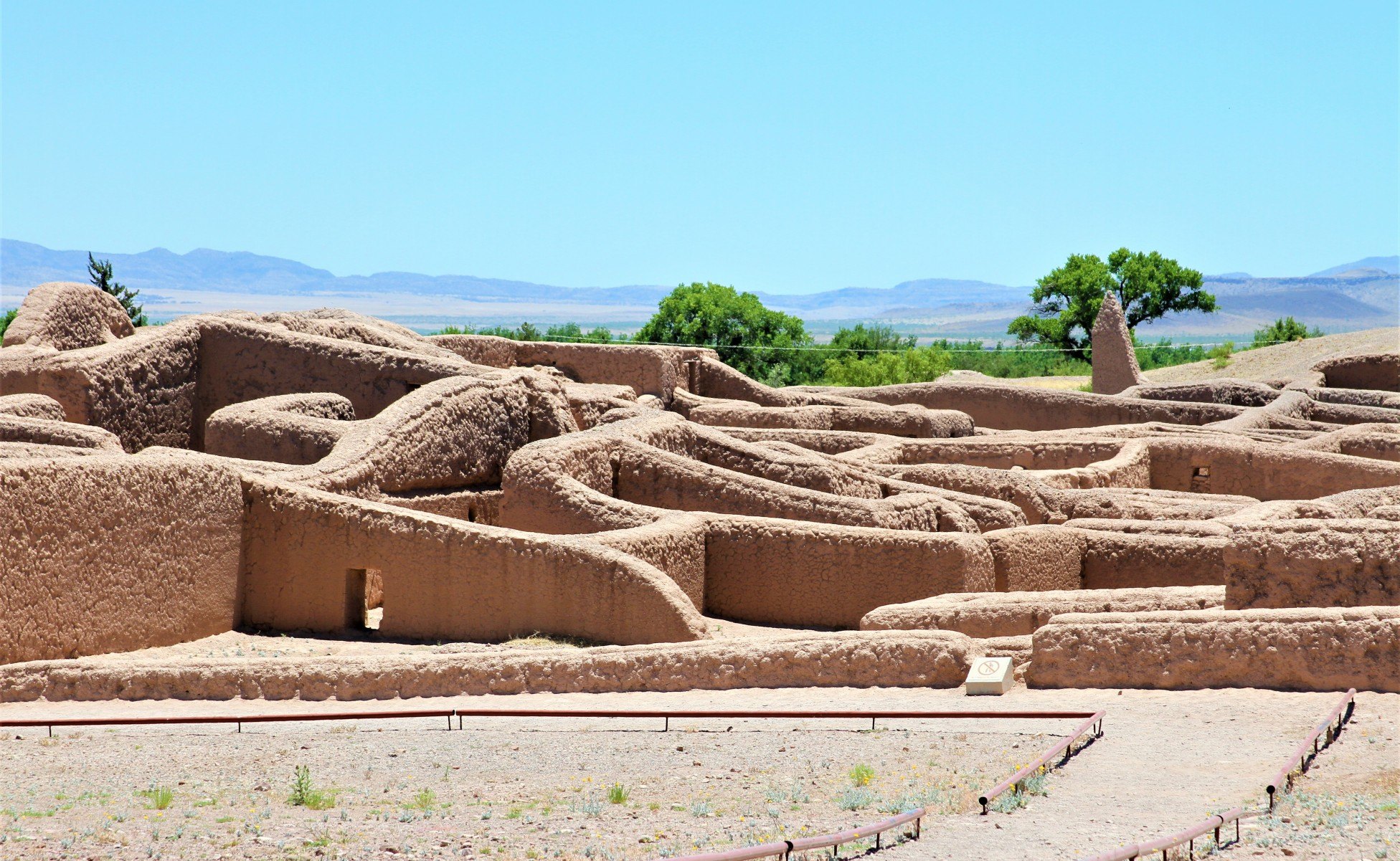
An adobe town at the foot of the Sierra Madre, in the desert of northwestern Chihuahua, with the most important archaeological site in northern Mexico at the end of its streets, and a base for the potters of Mata Ortiz and the Mormon colonies of the valley.
Key facts
| What it is | The seat of the municipality of Casas Grandes, a Pueblo Mágico (Magical Town) since 2015, which grew around a seventeenth-century Franciscan mission; Paquimé, a UNESCO World Heritage Site, lies on its edge |
| Where | Northwestern Chihuahua, in the Casas Grandes river valley; off the Chepe train line and far from the Sierra Tarahumara |
| Road distance | From Chihuahua city: 296 km 184 mi, about 4 h 15 min · from Ciudad Juárez (Paso del Norte bridge): 290 km 180 mi, about 4 h 15 min · from Creel: 413 km 256 mi, about 6 h 35 min |
| The city next door | Nuevo Casas Grandes, 9 km 6 mi away, about 10 min: most hotels, gas stations and banks are there |
| Elevation | About 1,475 m 4,840 ft |
| Population | 7,134 in the town (2020 census); Nuevo Casas Grandes, 62,038 |
| Time to allow | Our suggestion: two days with one night, one for the town and Paquimé, the other for Mata Ortiz or Colonia Juárez |
| Best season | March to May and October to November; June is the hottest month and winter nights drop below freezing |
| Where to stay | One hotel in the town itself and several in Nuevo Casas Grandes that you can book online (details below) |
| Safety | The U.S. lists the state of Chihuahua at Level 3, Reconsider travel; the UK and Canada advise against non-essential travel to this part of the state (details below) |
Almost everyone who comes to Casas Grandes comes for Paquimé, and rightly so. But the town deserves more than the archaeological site's parking lot: a plaza with its church, streets of earthen houses, a valley of orchards and, less than half an hour away, two places unlike anything else in Chihuahua: a village of potters and a colony founded by Mormons in the nineteenth century. Everything about the archaeological site (museum, walk, hours and tickets) and Mata Ortiz in depth is in our guide to Paquimé and Mata Ortiz; here we cover what the town is like and how to plan the trip.
Casas Grandes in brief
The name comes from the ruins. In 1566 the explorer Francisco de Ibarra described the ancient city of Paquimé as being "of great grandeur, height and strength," with buildings up to seven stories high. Those great houses, *casas grandes*, gave the place its name.
A mission and presidio town. The town was founded in the seventeenth century around the Franciscan mission of San Antonio de Padua, the patron saint whose church still stands on the plaza. In 1687 the presidio of San Antonio de Casas Grandes was established here, one of the forts the Spanish Crown used to guard the northern frontier of Nueva Vizcaya.
The Revolution came through. On March 6, 1911, revolutionary troops led in person by Francisco I. Madero attacked the town's federal garrison and lost the Battle of Casas Grandes; Madero was wounded.
Pueblo Mágico since 2015. Mexico's federal Tourism Ministry added it to the program in 2015. It is one of Chihuahua's five Pueblos Mágicos, and the only one in the northwest of the state; our guide to the Pueblos Mágicos of Chihuahua compares it with the other four.
Casas Grandes and Nuevo Casas Grandes
They are two different places, in two different municipalities, and it pays not to mix them up when you book. Casas Grandes is the old town, small and quiet, next to Paquimé. Nuevo Casas Grandes was born in 1897 around a station on the railroad from Ciudad Juárez, a few kilometers to the north, and grew into the commercial city of the northwest of the state. That is where you sleep, fill up and get cash; Casas Grandes is where you spend the day.
Paquimé, the reason for the trip
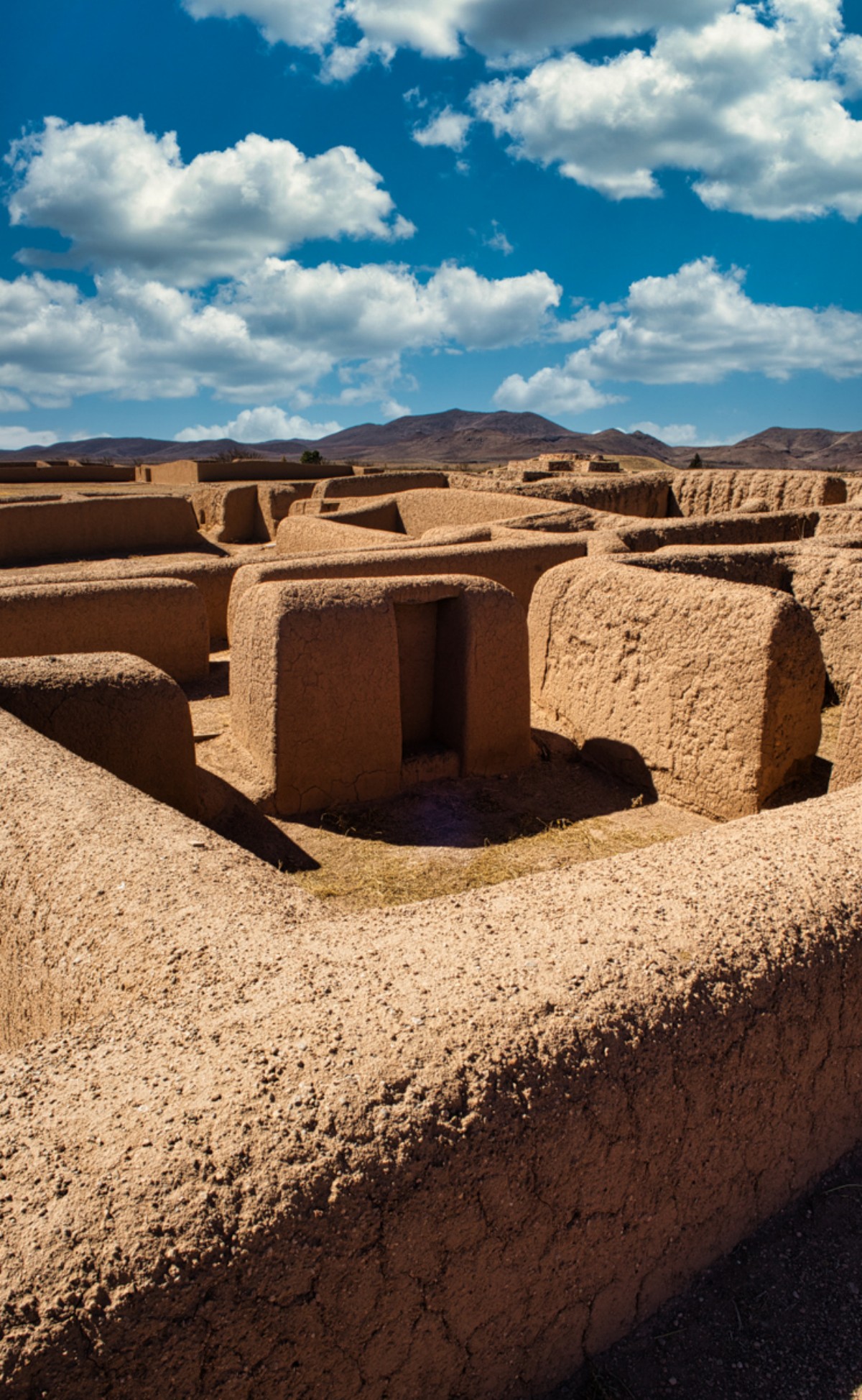
Paquimé was a city of rammed earth that, at its peak in the fourteenth and fifteenth centuries, traded with Mesoamerica and with the peoples of what is now the U.S. Southwest: macaws, shell, turquoise and copper passed through here. It has been a UNESCO World Heritage Site since 1998, and its Museo de las Culturas del Norte (Museum of the Cultures of the North), next to the site, explains what you see in the walls.
The entrance is 1 km 0.6 mi from the town plaza, along Calle Allende. The site and museum open Tuesday to Sunday, 9:00 to 17:00, with last entry to the site at 16:00, and close on Mondays: that is the first thing to check when you choose your dates.
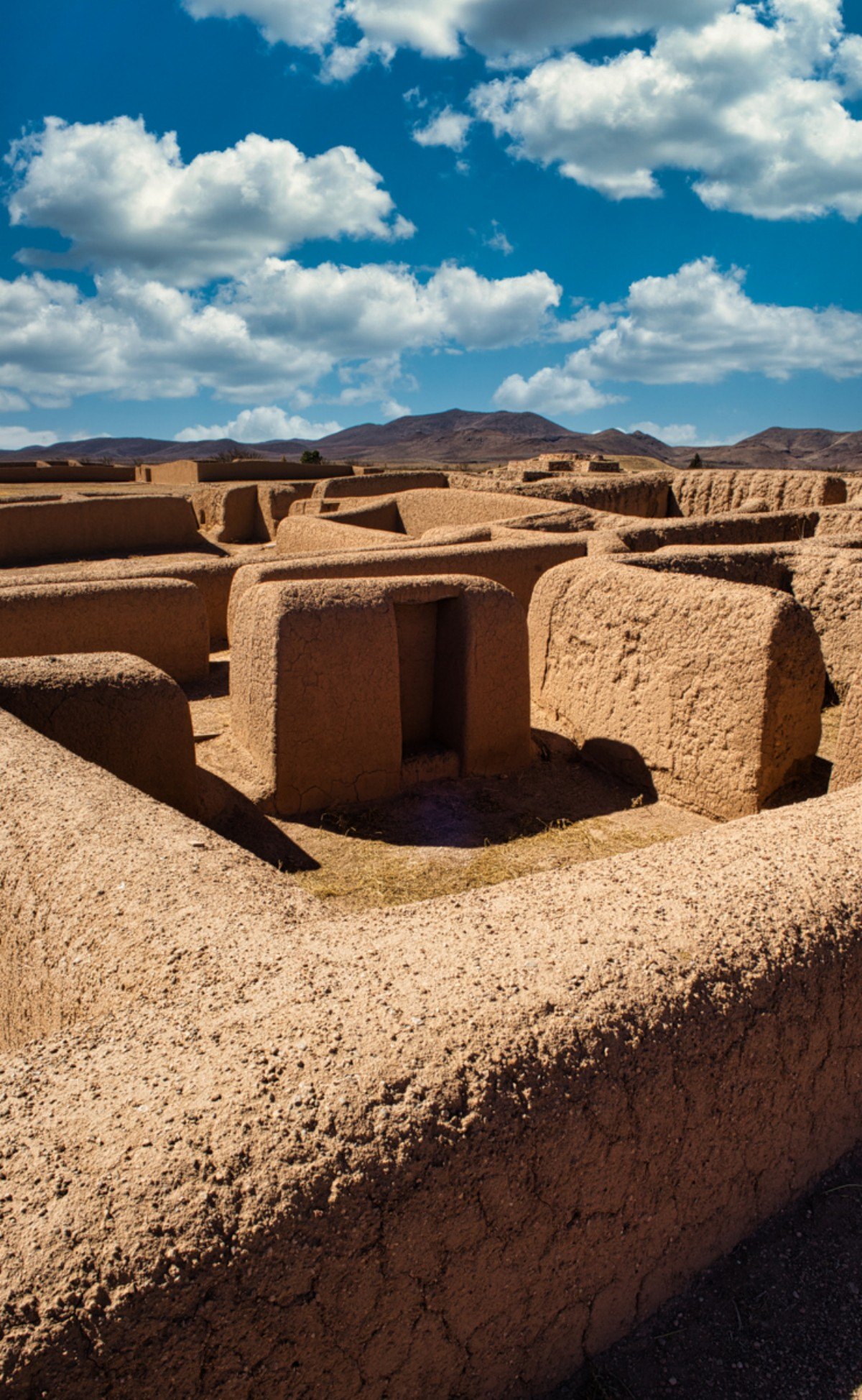
Our suggestion is 2 to 3 hours there, arriving early in summer. For the full walk, the ticket, the museum rules, the city's history and the day tour from Chihuahua, read our guide to Paquimé and Mata Ortiz.
What to see in town
You can walk Casas Grandes in an hour or two. Don't expect a monumental center: what it has is the pace of a northern farming town, with adobe houses and open space.
The plaza and the church of San Antonio de Padua. The patron saint's church stands on the main plaza, where the town began as a seventeenth-century Franciscan mission. It is the natural starting point for any walk, and Calle Allende runs from there to Paquimé.
The adobe streets. The adobe that made Paquimé famous is still the town's building material. Walking the blocks around the plaza is the best way to see why earth works in a climate of 35 °C 95 °F in summer and frost in winter.
The Capilla del Señor de la Misericordia. A chapel whose interior was painted by the Chihuahua artist Grisel Ortiz. We found no published address or hours; ask on the plaza for directions.
The river and the valley. The town sits on the Casas Grandes river, in a valley of grassland and orchards at the foot of the Sierra Madre Occidental. People hike, mountain-bike and birdwatch in the area, but we found no official marked trails; ask your hotel about local guides.
What to eat and drink. Try sotol, the region's spirit, as an aperitif; a snack of cuajada and requesón (fresh curd cheeses) or Mennonite cheese; a dish of carne seca (dried beef), barbacoa or a good steak; burritos with red chile or with beans and cheese; and, for dessert, peaches or apples from the valley. The valley also has vineyards and sotol distilleries that host tastings; we found no published hours, so ask your hotel which ones take visitors. We don't name restaurants because we couldn't confirm which are still open; ask your hotel.
Around town, beyond Paquimé
The best thing about staying a night is what lies within an hour. You need a car for all of it: we found no public transport to these places.
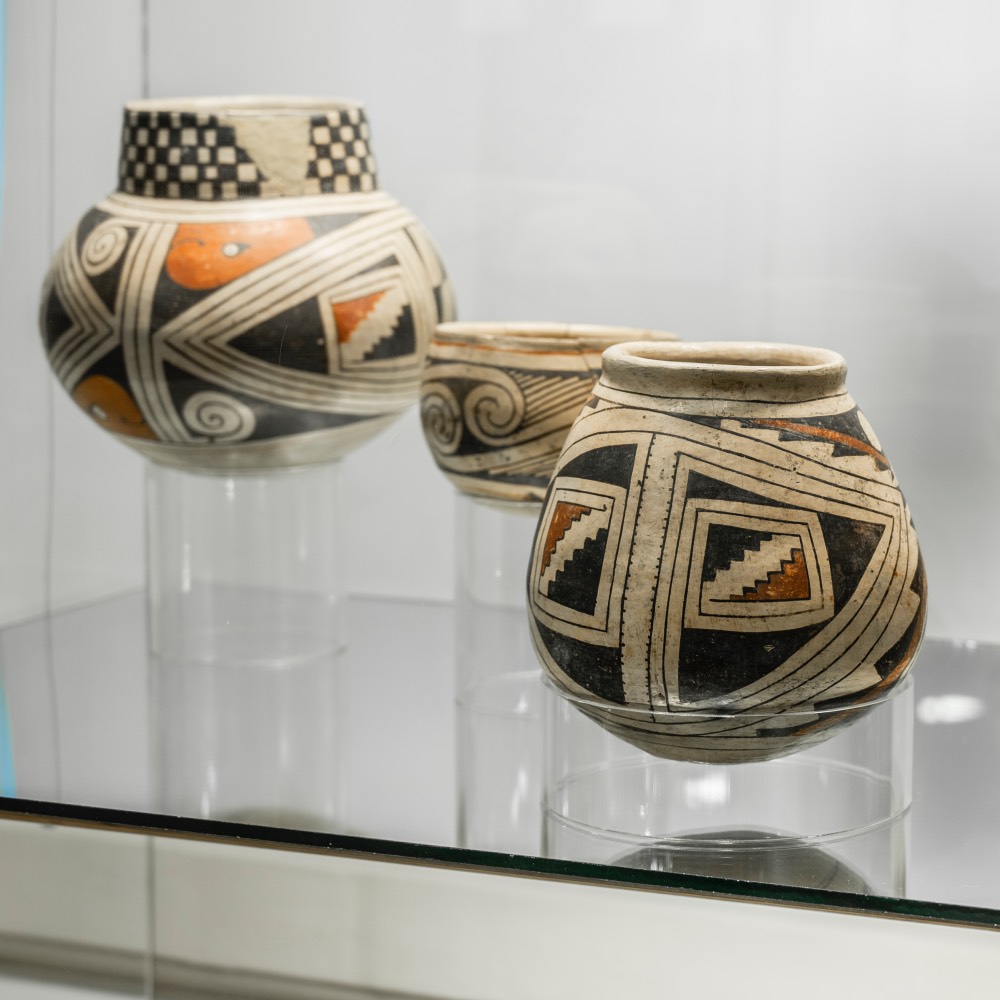
Mata Ortiz, the potters' village. 28 km 18 mi to the south, about 35 minutes. This is where Paquimé-style pottery was revived in the 1970s, made by hand without a wheel and fired with dung or bark; more than 450 potters live in the village today, and you can buy a pot from the person who made it. Half a day is enough. How to visit the workshops and buy is in our guide to Paquimé and Mata Ortiz.
Colonia Juárez. 16 km 10 mi to the southwest, about 20 minutes, in the Piedras Verdes river valley. Mormon settlers from the United States founded it in 1886, and it still shows: American-style houses from the early twentieth century, peach and apple orchards, the Victorian brick building of the Academia Juárez, from 1904, today a school run by the same church, and a small temple of The Church of Jesus Christ of Latter-day Saints, dedicated in 1999. The temple can only be seen from outside; the streets and orchards are open to wander. It is a walk of an hour or two that pairs well with Mata Ortiz, farther south.
Colonia Dublán. The other Mormon colony of the valley, 12 km 7 mi from town, about 15 minutes, now part of Nuevo Casas Grandes. If you sleep in Nuevo Casas Grandes, it is on your way.
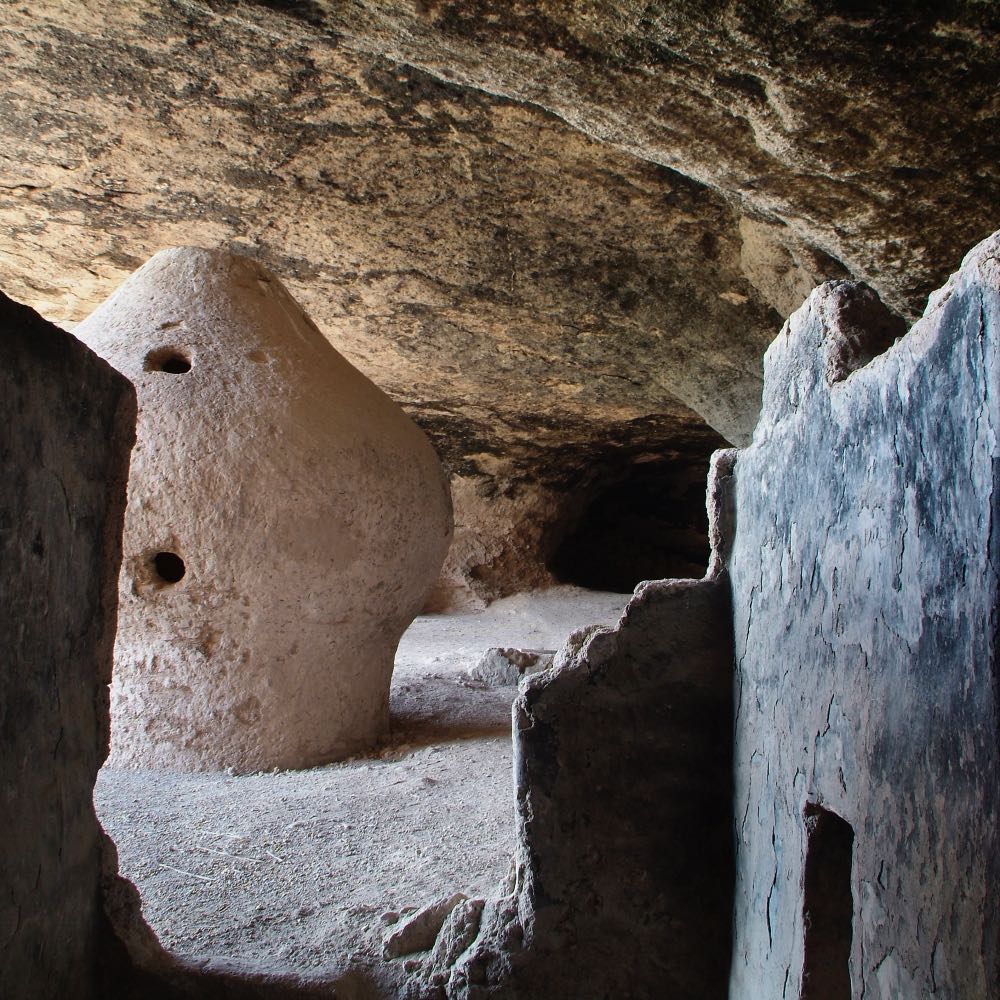
Cueva de la Olla. Adobe buildings inside a cave in the sierra, with a huge pot-shaped granary, about 48 km 30 mi southwest of Paquimé. It opens Tuesday to Sunday, 9:00 to 17:00, with last entry at 15:00, and entry is free. The road is rural and remote: go in daylight with a full tank. Directions are in our Paquimé guide.
More places you'll hear about. The Pueblo Mágico's official attractions also include the Arroyo de los Monos, with petroglyphs of human and animal figures; the Cueva de las Golondrinas (Swallows' Cave), with nests and rock paintings; and the Valle de los Piloncillos, with large boulders shaped like cones of piloncillo sugar. We found no official information on access, hours or road conditions for any of the three; if they interest you, hire a local guide and don't go on your own.
The Janos Biosphere Reserve. Grasslands with prairie-dog colonies and the first bison herd reintroduced in Mexico, in 2009, near the town of Janos, which is 69 km 43 mi north of Casas Grandes, about 1 hour. It is a protected area: you can't roam it freely, so ask ahead how to visit.
Weather, festivals and the best time to go
Casas Grandes is high desert, with an extreme semi-arid climate. These are the shapes of the year, with the long-term normals from the Nuevo Casas Grandes weather station:
- March to May is dry and mild, the best time to walk the town and the site, though spring brings strong winds and dust storms.
- June is the hottest month, with average highs of 34 °C 93 °F and days that reach 35–38 °C (95–100 °F). Start early.
- July and August bring most of the year's rain, in strong, short storms; July averages 79 mm (3.1 in) of about 327 mm (12.9 in) a year.
- October and November are mild and clear, and they hold most of the town's festivals.
- December to February has mild afternoons, with highs around 16 °C 60 °F, but in January the average low is −2 °C 29 °F and it sometimes snows.
The month-by-month table is in our guide to Paquimé and Mata Ortiz.
Festivals to plan around. Dates are approximate and change from year to year; confirm them before you book.
| When | What |
|---|---|
| February–March | Cabalgata Binacional Villista, a horseback ride honoring Pancho Villa's revolutionaries |
| August 9 | Omáwari, a gathering of Indigenous peoples of the U.S. Southwest and northwestern Mexico |
| September 8 to 16 | Anniversary of the town's founding |
| Around October 5 | Mata Ortiz Pottery Competition |
| Second half of October | Casas Grandes Festival, with workshops, talks, dance and music |
| Second half of November | Feast of Our Lady of the Miraculous Medal |
How to get there
There is no train to Casas Grandes: the Chepe runs from Chihuahua city to Creel and the sierra, far to the south. You arrive by road, in your own car, on a tour or by bus to Nuevo Casas Grandes. The nearest airports with commercial flights are Chihuahua (CUU) and Ciudad Juárez (CJS), plus El Paso on the U.S. side.
| Starting point | Road distance to Casas Grandes | Driving time (no stops) | Roads | Notes |
|---|---|---|---|---|
| Chihuahua city | 296 km 184 mi | about 4 h 15 min | MEX 45D toll road north, then MEX 10 via Buenaventura | The usual route; the guided tour leaves from here |
| Ciudad Juárez (Paso del Norte bridge, El Paso) | 290 km 180 mi | about 4 h 15 min | CHIH 174, MEX 2, MEX 10 | A border-to-interior drive; read the safety section first |
| Puerto Palomas (Columbus, New Mexico) | 193 km 120 mi | about 2 h 50 min | MEX 2, MEX 10 | The closest crossing from the U.S. |
| Creel | 413 km 256 mi | about 6 h 35 min | CHIH 25, CHIH 15, MEX 10 | Not a day trip; plan it as a separate leg |
And once in the valley, from the Casas Grandes plaza:
| Destination | Road distance | Driving time |
|---|---|---|
| Nuevo Casas Grandes | 9 km 6 mi | about 10 min |
| Colonia Dublán | 12 km 7 mi | about 15 min |
| Colonia Juárez | 16 km 10 mi | about 20 min |
| Mata Ortiz | 28 km 18 mi | about 35 min |
| Janos | 69 km 43 mi | about 1 h |
Times are pure driving at normal speed; on the long legs, add at least half an hour for fuel, tolls and food.
From Chihuahua city. Take the toll road toward Ciudad Juárez and, at kilometer 103, the exit for Ricardo Flores Magón; from there follow the road to Buenaventura and Nuevo Casas Grandes.
From the United States. If you drive a U.S.-registered car beyond the border zone, you need a temporary vehicle import permit, an FMM entry permit for each traveler and Mexican liability insurance. Our guide to driving to Copper Canyon explains each step.
By bus. Long-distance buses run from Chihuahua and Ciudad Juárez to Nuevo Casas Grandes, but we found no schedules published by the bus lines themselves, so we don't give times or fares; confirm them at the bus station a day ahead. From Nuevo Casas Grandes to Casas Grandes you'll need a taxi.
How long to stay, and sample plans
Our view: Casas Grandes doesn't work well as a day trip. From Chihuahua or the border it is more than four hours each way, and the travel advisories say not to drive between cities after dark. With one night you see Paquimé without rushing and have the next morning for Mata Ortiz or Colonia Juárez.
Two days by car from Chihuahua city
- Day 1. Leave after breakfast and reach Casas Grandes in the early afternoon. Eat in town, visit the museum and the Paquimé site before the 16:00 last entry, and finish with a walk around the plaza. Night in Casas Grandes or Nuevo Casas Grandes.
- Day 2. Morning in Colonia Juárez and Mata Ortiz, which lie in the same direction. Drive back to Chihuahua in the early afternoon to arrive in daylight.
Three days
- Add the Cueva de la Olla, or a full day in Mata Ortiz with time for several workshops. If you coincide with the October pottery competition, book your hotel ahead.
If you'd rather not drive
Civitatis sells a Paquimé and Mata Ortiz Day Trip that picks you up at your hotel in Chihuahua city, with an English- and Spanish-speaking guide, entry to the site, a pottery demonstration and lunch in Mata Ortiz. It is advertised as 8 hours, but the round-trip drive alone is more than eight, so expect a much longer day. It includes no time in the town of Casas Grandes or in Colonia Juárez; what it includes and what it doesn't is in our Paquimé guide.
Remember Mondays. Paquimé, its museum and the Cueva de la Olla close on Mondays: don't leave them for that day.
To combine with other trips in the state, see our guide to Chihuahua beyond the train.
Where to stay, money and fuel
In town. If you want to wake up in Casas Grandes, close to Paquimé, you can book PUEBLO DEL SOuL at Paquime, in the town itself.
In Nuevo Casas Grandes. The city next door has more choice, about 10 minutes from the plaza. You can compare hotels in Nuevo Casas Grandes on Booking.com. Three you can book there:
We haven't stayed at them; read recent reviews before you book. If you travel for the October pottery competition or the September festivities, book early.
Money and fuel. Nuevo Casas Grandes, the commercial city of the area, is where you'll find more banks, ATMs and gas stations. Leave it with a full tank and pesos in cash for Mata Ortiz, the Cueva de la Olla and the town's shops: we couldn't confirm card payment at those places.
Is it safe to visit Casas Grandes?
Three governments publish advice that covers Casas Grandes and the roads to it:
- United States. The U.S. State Department advisory for Mexico issued on May 29, 2026 lists the state of Chihuahua at Level 3, Reconsider travel, due to terrorism, crime and kidnapping. Among the travel restrictions for its employees, which it strongly advises U.S. citizens to follow: they "may not travel between cities after dark," "should avoid traveling alone, especially in remote areas," and "may not drive between Mexican border cities and the interior of Mexico, with limited exceptions." The advisory includes a map of restricted areas; check it for Casas Grandes before you go.
- United Kingdom. The UK government's advice for Mexico (updated October 20, 2026) is against all but essential travel to the state of Chihuahua, except for Chihuahua city, the Ciudad Juárez border crossing and federal toll roads 45 and 45D, the Copper Canyon railway route with Creel, the road from Creel via San Juanito to San Pedro, and state highway 16 from San Pedro to Chihuahua. Casas Grandes, Nuevo Casas Grandes, Mata Ortiz and MEX 10 are not among those exceptions. The UK government also warns that travelling against its advice can invalidate your travel insurance.
- Canada. The Government of Canada's advice (last updated November 18, 2026) is to avoid non-essential travel to the state of Chihuahua, excluding Chihuahua city.
Our view: we don't tell you a place is "safe" or "dangerous" beyond what these governments say. If you decide to go, these steps follow their advice:
- Drive only in daylight, and plan each leg to arrive before dark.
- Prefer toll roads (numbers followed by a D) when you have a choice.
- Consider the guided tour from Chihuahua instead of driving yourself from the border.
- Don't travel alone to the Cueva de la Olla or on rural roads, tell someone your route and arrival time, and carry a charged phone; signal drops in the countryside.
- Check that your insurance covers this region before you book.
- Read the advisories again shortly before your trip; they change.
More context on the region: Copper Canyon safety.
Printable checklist
Tick the boxes on screen, or print each list on its own sheet.
Before you go
In your bag
Frequently asked questions
What is there to do in Casas Grandes, Chihuahua?
Visit Paquimé and its Museum of the Cultures of the North, walk the plaza and the church of San Antonio de Padua, buy pottery in Mata Ortiz, 35 minutes away, and wander Colonia Juárez, the valley's Mormon colony, 20 minutes away. With one more night, the Cueva de la Olla.
What is the difference between Casas Grandes and Nuevo Casas Grandes?
Casas Grandes is the old town next to Paquimé, the Pueblo Mágico, with 7,134 people. Nuevo Casas Grandes is the commercial city that grew from the railroad in 1897, 9 km 6 mi away, with more than 60,000 people; most hotels, banks and gas stations are there.
How far is Casas Grandes from Chihuahua city?
296 km 184 mi by road, about 4 hours 15 minutes of driving without stops, on the toll road toward Ciudad Juárez and then MEX 10 via Buenaventura.
How far is Casas Grandes from Ciudad Juárez and El Paso?
290 km 180 mi from the Paso del Norte bridge, about 4 hours 15 minutes. From Puerto Palomas, across from Columbus, New Mexico, it is 193 km 120 mi, about 2 hours 50 minutes.
Since when has Casas Grandes been a Pueblo Mágico?
Since 2015. It is one of Chihuahua's five Pueblos Mágicos, along with Creel, Batopilas, Guachochi and Hidalgo del Parral.
Can you see Casas Grandes in a day?
From Chihuahua or the border, the round trip is more than eight hours of driving, so only on the guided tour and expecting a very long day. We recommend two days with a night in the town or in Nuevo Casas Grandes.
Recommended hotels
Recommended tours
Send me this guide
Everything on this page in your inbox: the schedules and the booking links. Handy for planning, printing or reading on the train.
Sources
- Secretaría de Turismo: Casas Grandes, Chihuahua
- Chihuahua Tourism: Casas Grandes
- UNESCO World Heritage Centre: Archaeological Zone of Paquimé, Casas Grandes
- INAH: Paquimé, visitor information
- INAH: Cueva de la Olla, visitor information
- INEGI: 2020 census, localities of Chihuahua
- Servicio Meteorológico Nacional: Nuevo Casas Grandes normals, station 8210 (1971–2000)
- Universidad Autónoma de Ciudad Juárez: anniversary of the Battle of Casas Grandes (2025)
- México Desconocido: Casas Grandes
- México Desconocido: 10 things to do in Casas Grandes
- Visit Casas Grandes: vineyards and sotol
- Wikipedia: Casas Grandes (Mexico))
- Wikipedia: Nuevo Casas Grandes
- Wikipedia: Colonia Juárez, Chihuahua
- Wikipedia: Janos Biosphere Reserve
- U.S. Department of State: Mexico travel advisory
- UK Foreign, Commonwealth & Development Office: Mexico travel advice
- Government of Canada: Mexico travel advice
- OpenStreetMap: road data (© OpenStreetMap contributors, ODbL)